Sales of apartments in the Cape Town CBD during April topped a phenomenal 49 units, with sellers realising prices on average just 5% below asking price.
Forty percent of April’s sales went within 10 days of listing, showing that confidence in CBD property is extremely strong. And sales since April have continued along the same trajectory.
“An analysis of the apartment sales concluded in the last month shows that the variance from listing price to concluded price has now dropped to around -5% on average,” says sectional title specialist agent Mariël Burger of Pam Golding Properties. “In many instances there is no variance whatsoever for correctly priced property, which not only indicates the confidence in the market but also the importance placed on the agent to correctly counsel and guide the seller as to the marketing price.”
A total of 14 apartments sold at asking price or above during April, with over 60% of sales being within 5% of asking price. The largest price variance recorded in the CBD itself was -11.6% for a 94m2 apartment in the Icon building in Hans Strijdom Avenue, which listed at R2.45m and sold for R2.195m. But in total over 90% of apartments sold in April were within the -10% price variance. April saw R84 557 000 worth of apartment sales in the CBD, at an average price of R1 725 653.
“The number of days it takes to conclude a sale has also dropped considerably to just over two months on average, although in many instances properties are being sold within days of listing. This again highlights again the critical value placed on the estate agent to effectively list and market the property to capitalise on positive market sentiment in order to conclude a sale in the shortest possible time and for the highest possible price,” says Burger.
Property in Cape Town’s CBD is all about location, convenience and security, but the underlying theme of the last three to four years has increasingly been value for money. In neighbouring suburbs such as Mouille Point and the V&A Waterfront, apartments are going for anywhere in the region of R50 000/m2, almost three times the average price of property in the Central City.
A diverse range of properties and prices is one of the Central City’s main attractions and, according to the 2013 edition of the Central City Improvement District’s (CCID) The State of Cape Town Central City Report, these have turned Cape Town’s CBD into one of South Africa’s strongest residential growth nodes. At the time of publishing the report (looking back at 2013 as a year in review) property in the CBD ranged from R8 140/m2 to R23 452/m2, with an average price per square metre last year sitting around the R17 500 mark.
The report also notes that the total value of apartment sales in the CBD increased from R145 million in 2012 to R249m last year, while the number of apartments that changed hands in Cape Town’s CBD increased from 132 in 2012 to 163 in 2013.
“In terms of rand value since 2010, apartment sales improved by 63%, and 51% in terms of units,” says Stefan Hauptfleisch, a residential property analyst at Cape Property Price Trends.
The increase in sales is way ahead of the average 20% recovery in sales volumes and values recorded across South Africa’s housing market for the year to date, according to First National Bank’s figures. This growth is confirmed by Propstats.co.za (a property industry statistics website), which shows a total of 91 sectional title apartments changing hands from January to the start of June 2014, for a total of R145 493 800 (or R1.599m on average per sale). This is already 12% more on average than the R1.428m buyers forked out last year.
With property values escalating in the CBD, “as they would in any successful downtown” notes CCID chairperson Rob Kane, the need has now arisen for more affordable housing options as close to the CBD as possible – for example, he elaborates “on the site of the old Good Hope Centre or the Culemborg area.”
Kane continues: “It’s vital, for a downtown to remain successful, that it is inclusive and offers opportunities across a range of prospective homeowner and rental tenants’ incomes, and brings them as close as possible to where they work. We believe that these possibilities exist on land still available on the peripheries of the CBD, some of which currently lies in the hands of local and provincial government.”
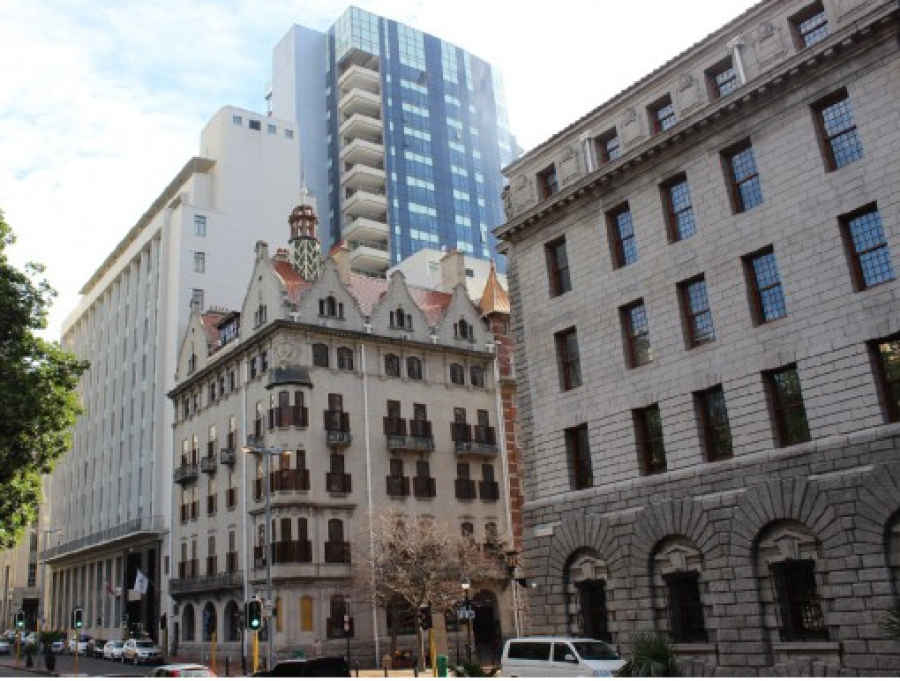
Photo of the Mandela Rhodes Place complex, which offers prime residential property options in the Cape Town CBD: Carola Koblitz, CCID.